


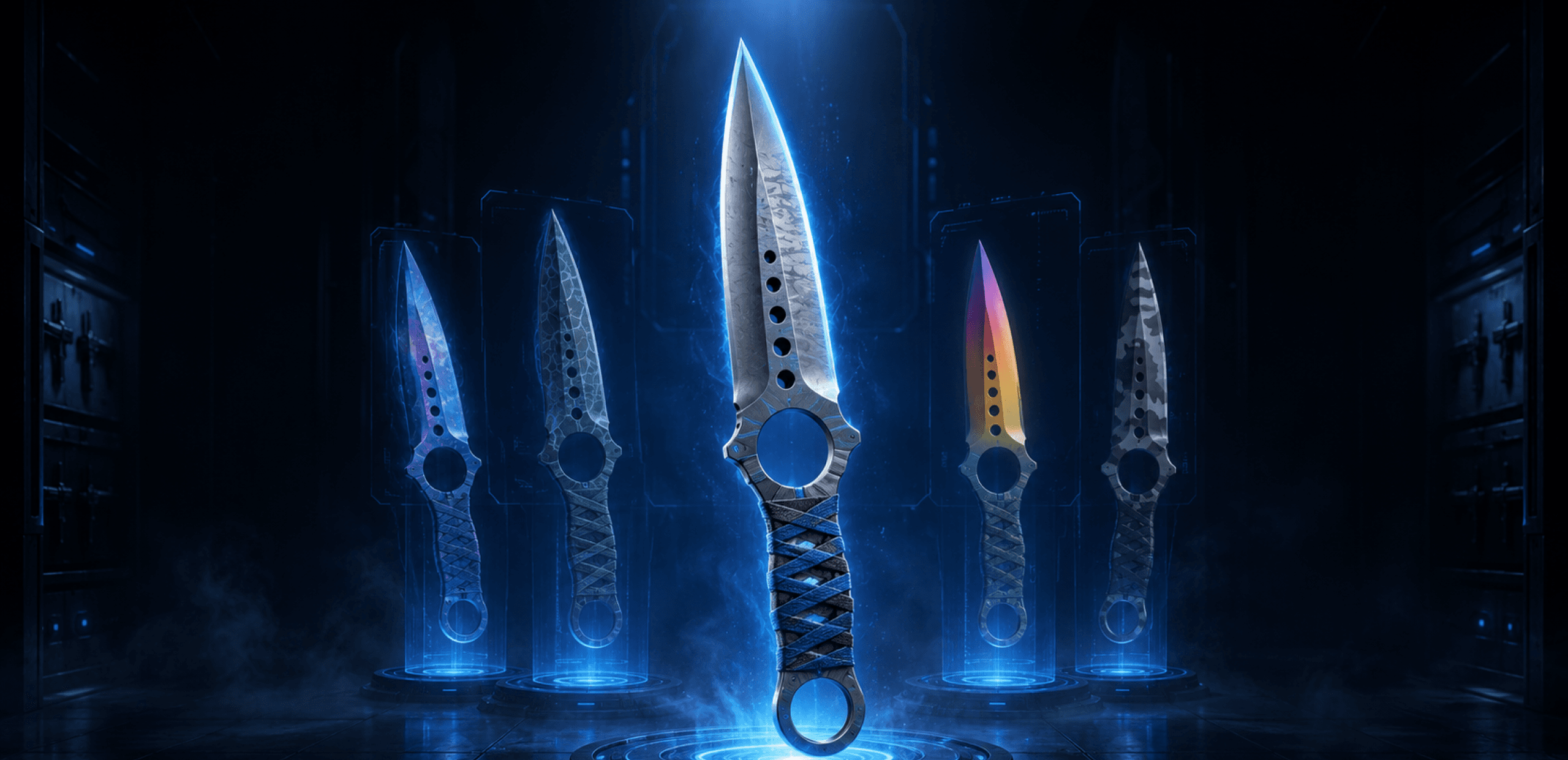

Skeleton Knife in CS2: Design, All Skins and Full Price Guide
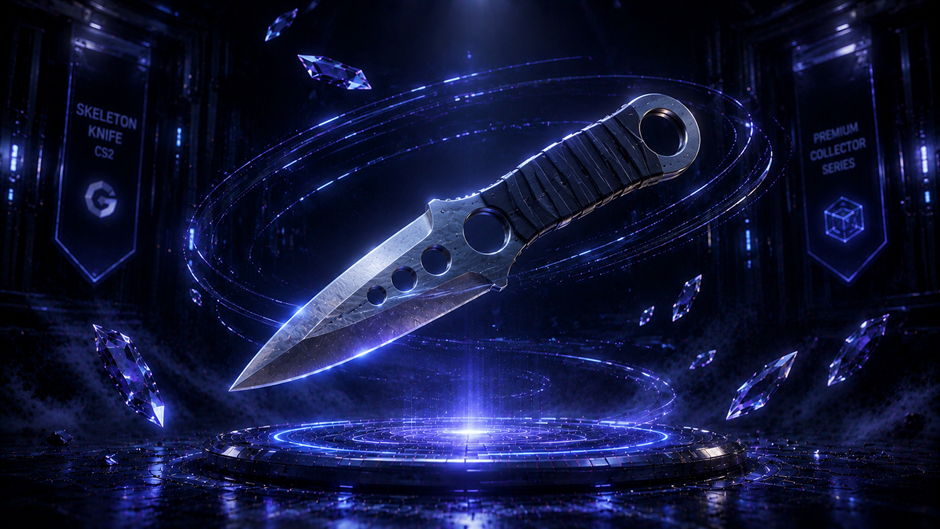
The Skeleton Knife CS2 design is immediately recognizable: cutouts run through the blade flat, creating open windows that no other CS2 knife type uses. Those cutouts change how skins display – the finish is visible from multiple angles simultaneously, which produces a different visual result than the same skin on a solid blade. The price range for skeleton knife skins runs from around $200 for budget options to well above $3,000 for top-tier Doppler phases.
This article covers every significant skin by category, with the pricing logic behind each one.
What Is the Skeleton Knife in CS2?
The Skeleton Knife in CS2 has a long single-edged blade with rectangular cutouts removed from the flat – the openings run along the mid-section of the blade, leaving the spine and edge intact while reducing the solid material between them. That construction is the defining feature of the knife and the origin of its name.
The inspect animation takes the cutout design further: the spinning sequence passes the knife through a grip rotation where the open blade sections are visible from multiple angles in a single fluid movement. No other CS2 knife uses a similar animation approach because no other knife has the same blade geometry to work with.
Operation Shattered Web introduced the Skeleton Knife to CS:GO in 2019 alongside several other new knife types. Among the knives added in that period, it established the fastest recognition in the community – the silhouette is distinct enough that it reads as a Skeleton Knife immediately in third-person view during play. That visual distinctiveness, combined with the animation, placed it in the upper tier of Covert-tier knife demand shortly after release.
Why the Skeleton Knife Stands Out Among CS2 Knives
On a solid-bladed knife, a finish covers one continuous surface per side. The Skeleton Knife works differently. The cutouts mean the blade has no continuous flat – the finish wraps around the edges of each opening, and light reaches the surface from angles that a solid blade blocks. The result is that the same finish displays more visual depth on a Skeleton Knife than on a knife without cutouts.
Pattern-based finishes are affected most directly. A Doppler phase on a solid blade shows the color gradient across one surface at a time. On a Skeleton Knife in CS2, the gradient is visible through the openings simultaneously – the front and back of the blade are both partially visible in a single view, which means the pattern reads as more three-dimensional than the same finish on a Marble Fade or Fade applied to a Karambit or Talon Knife.
That display behavior makes skin selection more consequential for this knife type than for most others. A finish that looks flat or low-contrast on a solid blade can read differently once the cutout geometry interacts with it. The reverse is also true: finishes that rely on a single uninterrupted surface for their visual impact – certain Crimson Web configurations, for example – behave differently when that surface has sections removed. Choosing Skeleton Knife skins with the cutout geometry in mind produces a more predictable result than selecting based on how the finish looks on another knife type.
Budget Skeleton Knife Skins (Under $350)
The cutout design is present at every price point – budget Skeleton Knife skins carry the same blade geometry and animation as premium options. The difference is finish complexity and demand, not the knife's structural visual identity.
Skeleton Knife | Urban Masked
A dark geometric camouflage pattern in grey and black tones covers the blade and handle. The low-contrast palette keeps the finish subdued, which means the cutout geometry reads more clearly than it would under a high-saturation design. Among the most accessible entry points for the Skeleton Knife in CS2, Urban Masked trades around $200-$250 in Field-Tested and $240-$280 in Factory New.
Skeleton Knife | Safari Mesh
Safari Mesh applies a light tan and brown mesh texture across the blade surface – a warmer, more neutral palette than Urban Masked. The sparser texture of the mesh pattern interacts with the cutouts differently than a solid camouflage block: the weave detail remains partially visible through the openings, adding a layered texture effect at low cost. Field-Tested copies trade around $210-$260, Factory New around $250-$300.
Skeleton Knife | Night Stripe
Dark diagonal stripes run across the blade in a high-contrast black and dark grey arrangement. The striped pattern crosses the cutout edges cleanly, which makes the transition between solid blade and open space visually defined rather than blurred. Field-Tested copies sit around $280-$320, with Factory New reaching $300-$350. Among budget Skeleton Knife skins, Night Stripe has the most structured visual layout of the three options in this category.
Mid-Range Skeleton Knife Skins ($350-$800)
At this price level, Skeleton Knife Skins move beyond camouflage and texture-based designs into finishes where the blade surface itself becomes the visual focus. Each skin in this category interacts with the cutout geometry in a distinct way.
Skeleton Knife | Vanilla
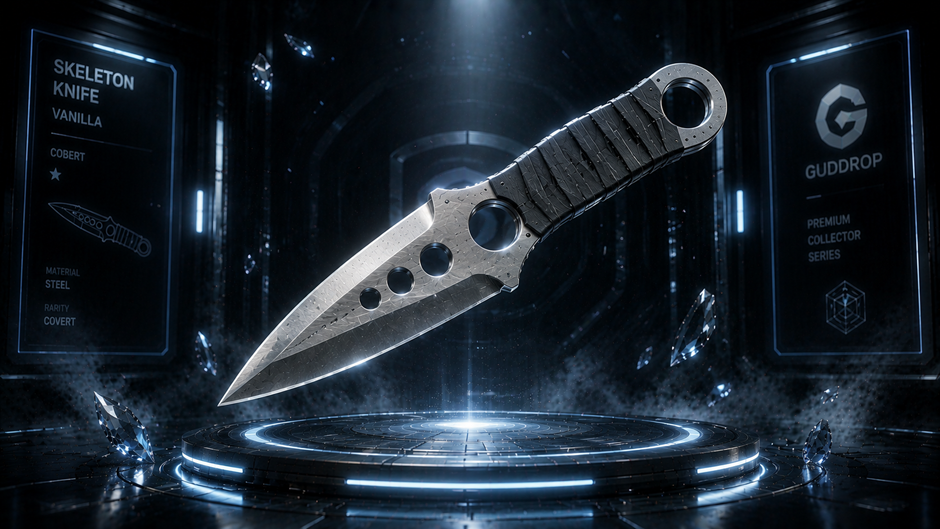
No finish is applied – the blade is bare steel with a factory grind visible across the surface and through the cutouts. On most knife types, Vanilla is valued primarily for float position within Factory New. On the Skeleton Knife, the cutouts add a dimension that solid-bladed Vanilla copies do not have: the open sections show the steel from both sides simultaneously, which makes the bare blade geometry more visually active than on a knife without openings. Factory New copies trade around $680-$720, with Minimal Wear sitting around $620-$670.
Skeleton Knife | Blue Steel
A blue-grey metallic finish with visible surface texture covers the blade. The color sits between steel and deep blue depending on lighting conditions, which produces different readings in different map environments. Among mid-range Skeleton Knife CS2 options, Blue Steel is one of the more consistent sellers – the finish works across the cutout geometry without relying on pattern variation to generate visual interest. Field-Tested copies trade around $380-$440, Factory New around $460-$520.
Skeleton Knife | Stained
A warm metallic finish with amber and brown tones, referencing oxidized steel. The color distribution is uneven by design – the staining effect produces lighter and darker patches across the blade surface, which interacts with the cutout edges to create a weathered appearance that reads as intentional rather than worn. Field-Tested copies sit around $360-$420, Factory New around $430-$480. Among mid-range options, Stained is visually distinct from the cooler-toned finishes that dominate this price category.
Premium Skeleton Knife Skins ($800+)
Premium Skeleton Knife skins divide into two groups: pattern-dependent finishes where the index assignment determines price as much as float, and high-demand finishes with consistent collector interest across wear grades.
Skeleton Knife | Crimson Web
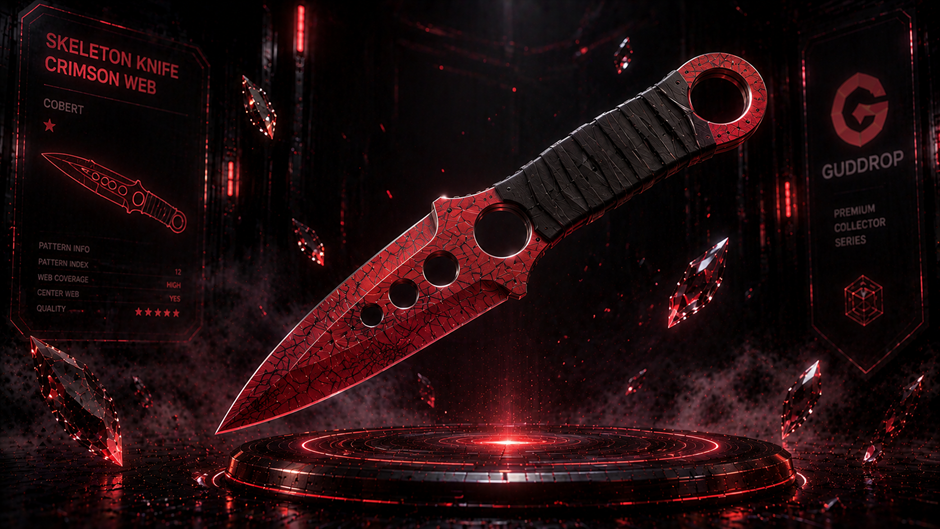
A red base finish with web patterns distributed across the blade surface. The number of web centerpoints on the p-side and their placement relative to the cutouts determines price more directly than float condition. A web centerpoint positioned at the center of the visible blade – between or near the cutout openings – is the most desirable configuration because it places the defining visual element of the finish in the area of highest visibility during inspect. Copies with multiple centered webs on the p-side command significant premiums over copies where webs appear near the edges or primarily on the a-side. Minimal Wear copies with strong web configurations start around $820 and rise significantly with better placement. Field-Tested copies with weak web positions trade well below that figure despite the same base finish.
Skeleton Knife | Slaughter
A red and white ornamental pattern runs across the blade – symmetrical curved line work against a deep red base. The design is high-contrast and reads clearly through the cutouts, which makes it one of the more visually complete finishes on this knife type. Among premium Skeleton Knife skins, Slaughter has maintained consistent demand since the knife's introduction. Factory New copies trade around $950-$1,200, with Minimal Wear sitting around $850-$1,000.
Skeleton Knife | Fade
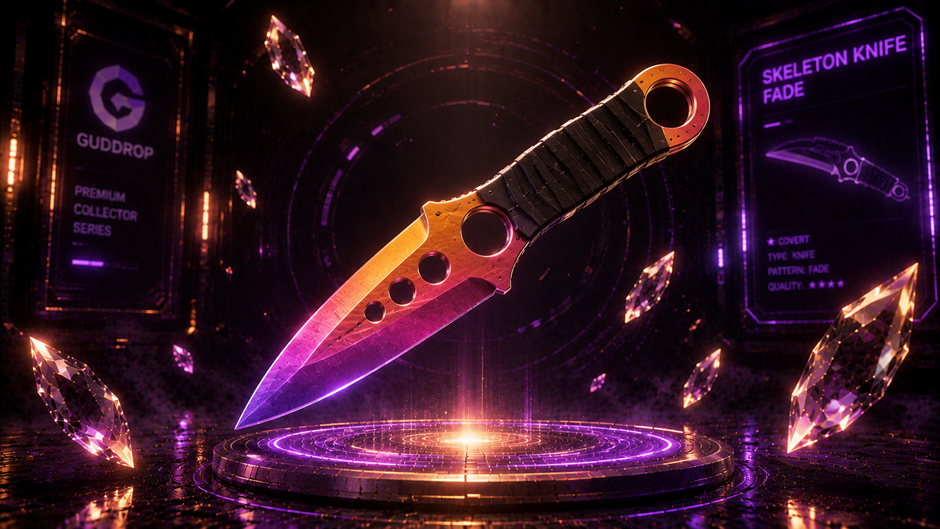
A gradient runs from yellow at the handle toward pink and purple at the tip. Fade percentage – how completely the gradient covers the blade without plain steel interruption near the handle – is the primary price variable within this finish. At 100% fade, the full gradient is visible from handle to tip. Partial fade copies show uncolored steel near the handle, which reduces visual completeness. The cutout geometry affects how the gradient reads: color transitions are visible through the openings as well as across the blade surface, which makes the finish more spatially complex than on a solid blade. Factory New copies at 100% trade around $1,200-$1,400, with partial fade copies sitting around $1,000-$1,150.
Skeleton Knife | Doppler
Phase assignment at unboxing determines the color distribution across the blade. Phases 1 through 4 each produce a different balance of pink, black, blue, and purple – Phase 2 and Phase 4 trade above Phase 1 and Phase 3 among standard phases due to community preference for blue-dominant and high-contrast results respectively. Above all standard phases sit Black Pearl, Ruby, and Sapphire, each with near-complete single-color or iridescent coverage. The cutout geometry means Doppler color is visible through the openings as well as across the surface, which makes phase color more spatially present on this knife than on a solid blade. Standard phases in Factory New trade from $700 to $1,200 depending on phase. Sapphire and Ruby copies trade from $3,000 and above.
The Cases section on GudDrop lists knife drops across multiple finish categories – checking current availability is the starting point before opening.
Which CS2 Cases Drop the Skeleton Knife?
The Skeleton Knife in CS2 is exclusive to two cases: the Fracture Case and the Shattered Web Case. No other CS2 case includes it in the knife pool, which means these two are the only routes to a Skeleton Knife through case opening.
The Fracture Case is the more accessible option by current market price. It sits in the active drop pool, which means new copies enter circulation through post-match drops and keep the per-unit cost relatively low. The knife pool covers all Skeleton Knife finishes including Fade, Crimson Web, and Doppler alongside the standard options. For players targeting a Skeleton Knife through case opening, Fracture Case offers the lowest cost per attempt of the two available options.
The Shattered Web Case is discontinued – it was removed from the active drop pool after Operation Shattered Web ended, and no new copies enter circulation through drops. Market price reflects that restricted supply and trades above the Fracture Case per unit. The knife pool overlaps significantly with Fracture, covering the same finish selection. The primary reason to open Shattered Web Case rather than Fracture is finish availability for specific configurations, not a structural difference in knife pool composition.
How to Get a Skeleton Knife on GudDrop
GudDrop carries a wide selection of cases with knife drops across multiple types and finish categories. The platform offers both standard CS2 cases and platform-exclusive cases, each with a documented content list visible before opening. For players targeting best Skeleton Knife CS2 options through case opening, checking which cases currently include Skeleton Knife in the knife pool is the starting point.
Opening a case on GudDrop follows the standard flow: log in via Steam, add balance to your account, select a case from the catalog, and press Open. The drop is assigned automatically and appears in your GudDrop inventory. If a Skeleton Knife CS2 drop occurs, the specific finish and pattern index are revealed at that point – neither is visible in advance.
GudDrop also runs an Upgrade mechanic where an existing skin can be risked against a higher-value target. For players who already hold a Skeleton Knife in a lower finish tier and want to try for a premium variant, that route is available alongside case opening – the original skin is lost on a failed attempt, so the odds and risk structure apply in the same way as any other upgrade attempt.
The Cases section on GudDrop shows the full content list for each case before any balance is committed, which makes it possible to confirm Skeleton Knife skins availability and cost per attempt before opening.
The Cases section on GudDrop is the starting point for checking current knife drop availability across all finish categories.
5 minutes read

Rare Skin Collection: Beyond the Game
7 minutes read
Karambit Blue Gem in CS2: Patterns, Prices and How to Get One
7 minutes read
The Best AWP Skins in CS2 in 2026: From Duality to Dragon Lore
11 minutes read

